
Feeling prepared is not the same as being prepared
What desirable difficulty research says about AI, sales, and the skills that only get built the hard way

One of the most amusing things I’ve learnt from working with B2B sales reps over the years is that what makes someone good at the job is often the unglamorous stuff. Activities like logging notes from a client meeting in the CRM, doing LinkedIn research on the people you’re meeting to understand their challenges and motivations, or even doing some simple Googling on the latest news in the prospect’s industry so you can drop in smart phrases at the right moment in the conversation.
There are only so many hours in the day, so this studious approach to sales isn’t scalable for every account and meeting. With organisational pressure to cover more ground, meet more clients, submit more opportunities, and generally ‘do more with less’, many sales folk end up skipping these steps.
Isn’t that the perfect setup for the AI pitch?
Call notes are captured by your AI note taker. Contact enrichment and org charts are generated in bulk and updated directly in your CRM. And when there’s news about your prospect, you get a summary delivered straight to your inbox. Meeting prep now takes 10 minutes instead of two hours. The efficiency gain is undeniable. In many cases, quality improves too, because most deals weren’t getting any prep or research time before.
I see the same trend across the reps I work with, and across the broader GTM support community. Some people promote this new world bluntly as the “end of your SDR team”. Others have a more nuanced view, and still see the value in going into a meeting with deeper knowledge.
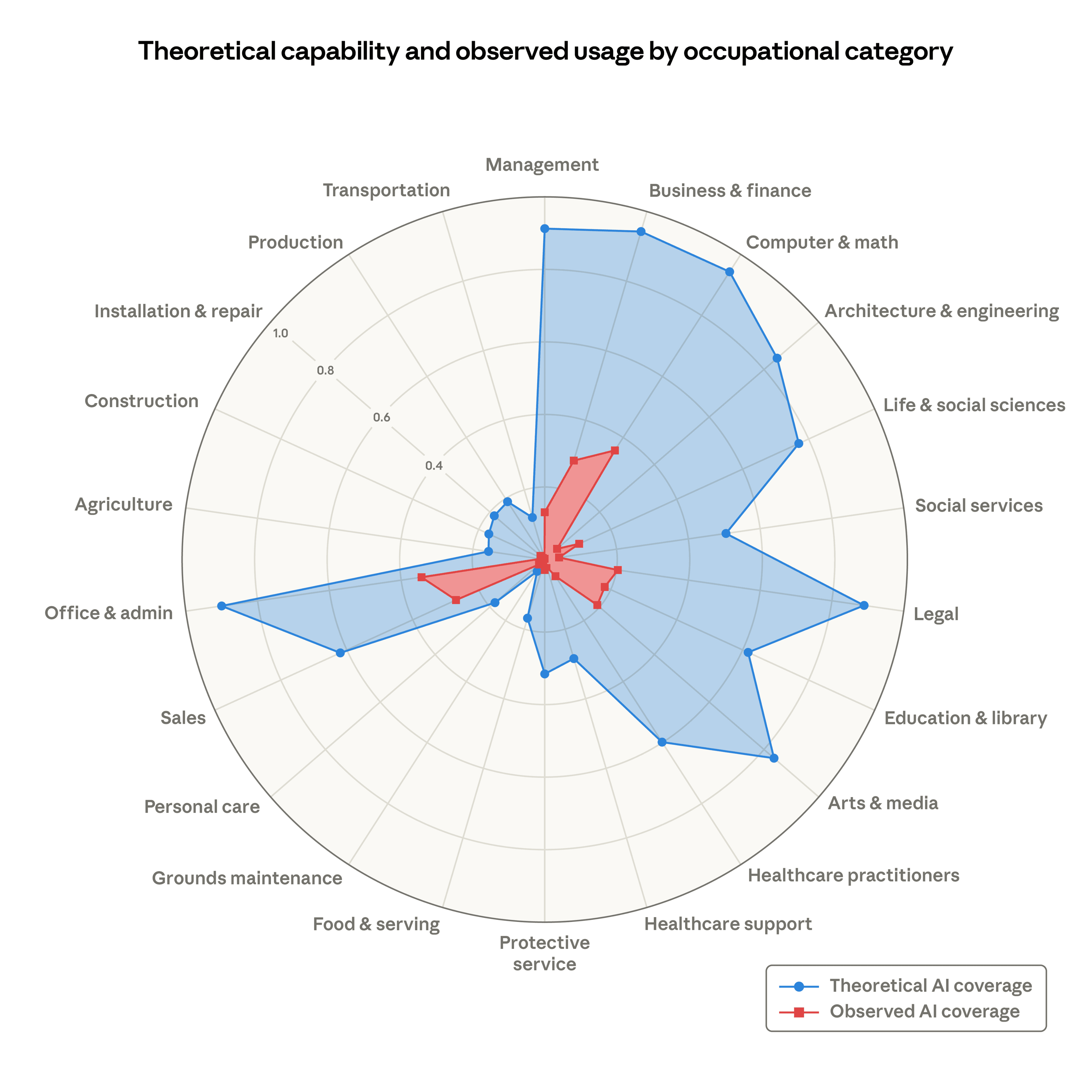
The wild thing is that we’re still in the very early stages of AI in Sales. Anthropic’s own research from earlier this year shows that AI’s actual coverage is a fraction of its full theoretical capability, especially in a category like Sales. So the behaviour I’m describing is only going to spread, not recede.
The technology is advancing so quickly and it’s exciting to be at the forefront of the experimentation. My friends and I nerd out over this stuff every time we meet so it’s understandable when a sales rep goes beyond simple productivity use cases (summarise, analyse) and starts to use AI for more strategic, creative and social applications. Instead of taking the information from AI research and summaries to think through a compelling pitch proposition, why not just ask the AI to create a strategy and pitch for you? It’s certainly faster, and if AI has average intelligence then the output won’t be that bad. At worst it’ll be average.
But here’s my hypothesis: Reps who outsource their full GTM flow to AI get worse over time, even though their output today looks fine.
Not worse output. Worse Reps.
I only started to understand why after a conversation a few weeks ago with a couple of friends who are deep in GTM Enablement and Training. AI-assisted onboarding and training programs are truly revolutionising the space and by all their metrics, reps are completing their training and self-reporting higher confidence with both the product knowledge as well as the seller skills. But over time, they started to notice reps going hard with AI and outsourcing their thinking to the tools. A dependency develops and many reps can’t actually come up with their own approach when presented with a client problem. The frictionless quality of AI might be making things too easy for us.
So what’s actually going on here? Robert Bjork’s research on Desirable Difficulties is the eye-opening answer (for me at least). He found that learning is durable only when you have to struggle to retrieve and organise information yourself. Passively reading something gives you the illusion of familiarity, but it’s the difficulty of working through it from scratch that actually encodes it. The struggle is the learning.
Here’s how this could play out:
In a pre-meeting prep context, the easy path (no struggle) looks like your AI of choice generating an account summary, suggesting discovery questions, producing a talk track. The rep reads it, feels prepared, goes in. This is an illusion though, the feeling of preparedness is just familiarity with the words and not actual comfort with the content.
This is where the struggle comes in: Ask that same rep to close the AI doc and rebuild the account picture from memory (what they actually understand, what they’d lead with, why) and watch where they hit a gap. “I read that they have budget set aside for a Q4 push, but I can’t think of an angle to tie my product to their challenge right now.” That gap is the signal the encoding didn’t happen yet. AI nails the summary but everything downstream of it is missing.
Why is this desirable? The research says that the struggle of recollection and reconstruction builds the pattern library. The rep who does this ten times before ten meetings is encoding deal patterns, client archetypes, product-fit logic. The rep who just reads the AI summary ten times is building familiarity with AI summaries.
So what happens in a Live meeting then? The same idea plays out but with higher stakes.
The difficulty happens when the client says something unexpected, something that your AI overview didn’t capture. Or they push back strongly and mention a competitor you didn’t prepare for. The talk track won’t work anymore for this precise moment.
The struggle in this scenario is to recall under pressure, in real time: the right questions, reframes, proof points to lead the prospect somewhere new. If the knowledge from earlier was properly encoded, this happens smoothly but if it’s missing, then the response is generic and won’t land.
The fun part about sales is that when you do this well, and it lands, that’s a story you can retain for the next time. I’d also guess that it gives your buyer confidence to bring you into their context, which matters in longer B2B sales cycles.
But that confidence, that value story, that earned trust in the room, isn’t available to the rep who handed the whole flow to AI. They got the average pitch, on time, and walked in feeling prepared, even though they weren’t. This rep continues hitting their activity numbers. The AI summaries keep landing in their inbox. From the outside, and probably from the inside too, everything looks fine. But there is a slow degradation of their own skills.
This is the asymmetry I am wrestling with: AI can hand you a fantastic product summary but what it can’t hand you is the ability to pull the right story in real time and position it for the specific person across the table. That skill only comes from having done that yourself enough times that it’s encoded. Outsourcing this from the start doesn’t give you the chance to develop the skill at all.
So I don’t think the question is whether reps use AI. They should, and they will. It’s an argument about design. If the struggle is what builds the rep, then the people like me who are building these tools and processes have to decide where to keep it on purpose.